Here’s a scenario that plays out regularly in global brands: the SEO team produces excellent English content that performs well in US and UK markets. The order comes from leadership to expand into three European markets. The content gets translated. The translated content gets published. Six months later, the European markets are underperforming – lower rankings, lower engagement, lower conversion – and the diagnosis is “SEO needs more work.”
The diagnosis is right. The understanding of what kind of work is usually wrong.
The problem is almost never the SEO mechanics – the hreflang, the URL structure, the keyword research in each language. Those might be done adequately. The problem is what happens when content that was written for one cultural and cognitive context gets transferred – through translation – into a different cultural and cognitive context where it doesn’t quite fit. Readers in that market experience something subtly off. They engage less. They convert less. The behavioral signals reflect that, and rankings reflect the behavioral signals.
Cognitive AI SEO for multilingual markets addresses this at the level where the problem actually lives.
Why Translation Creates a Cultural Fit Gap
Language and culture are inseparable in ways that translation doesn’t address. When content is written in English for an American audience, it embeds dozens of assumptions that American readers don’t notice because those assumptions are shared. The examples chosen resonate with American professional or consumer experiences. The rhetorical structure follows conventions that American readers find naturally persuasive. The level of directness, the relationship between writer and reader implied by the prose, the implicit understanding of what “doing your research” means – all of these are culturally specific.
When that content is translated accurately into German, the words are correct but the cultural fit is approximate. German professional audiences have different expectations for how expertise gets demonstrated – they tend to expect more depth, more technical precision, more acknowledgment of complexity than American content typically provides. German readers are more likely to read thoroughly and scrutinize claims. The direct-benefit-first American content structure often feels superficial or insufficiently rigorous by German standards.
Japanese audiences have radically different expectations around content structure – indirect approaches to main points, collective perspective rather than individual authoritative voice, different visual and information density norms. Content written in Japanese that’s been translated from American English doesn’t just read awkwardly; it reads as culturally foreign in ways that undermine trust.
What Cognitive AI SEO Brings to This Problem
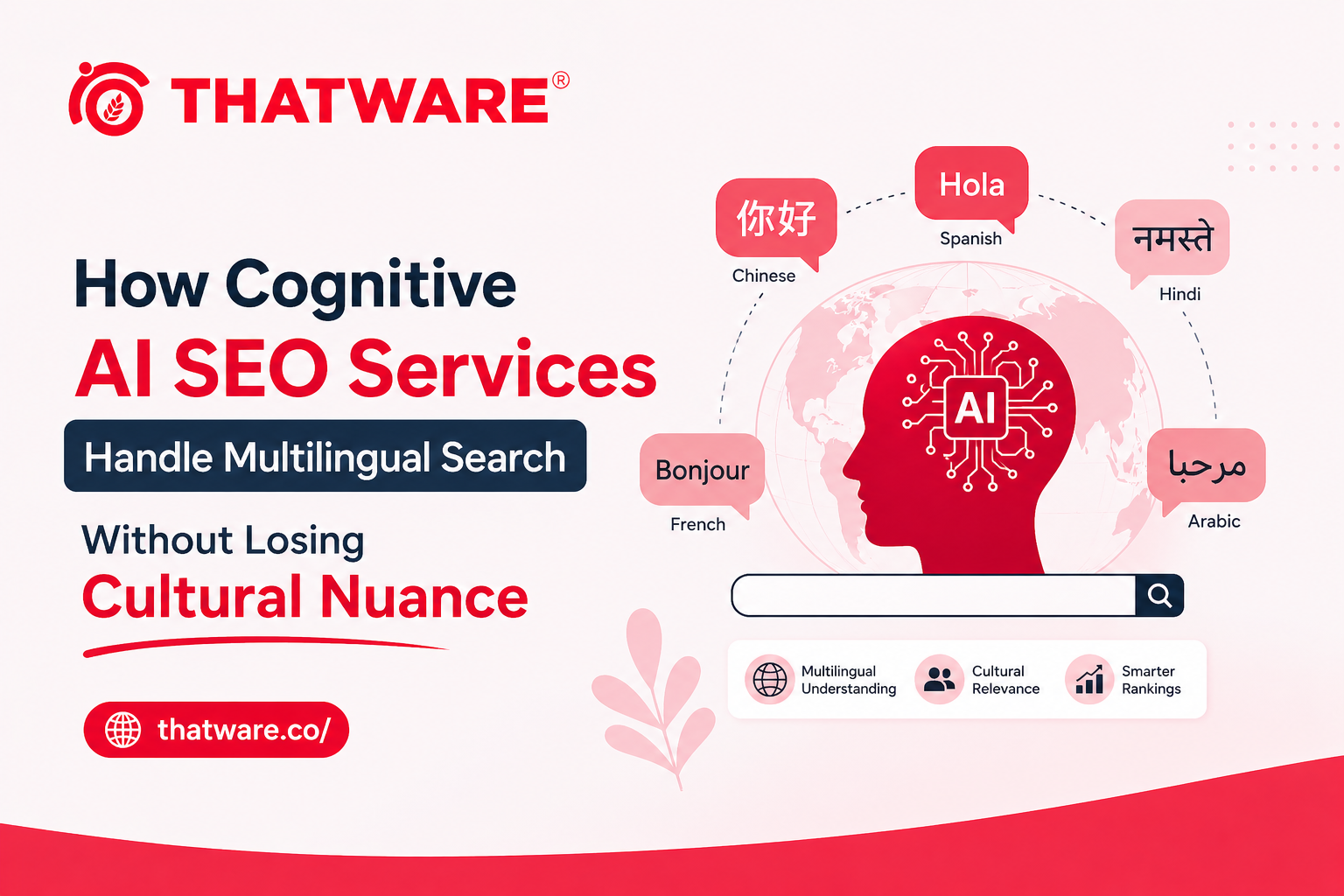
Cognitive ai seo services applied to multilingual search address the cultural fit problem by working at the cognitive layer – how readers in each market process information, what persuasion conventions they respond to, what content structures feel authoritative versus superficial in each cultural context.
This means content strategy for each target market that starts from the cognitive norms of that market rather than from the source content. Not “how do we adapt this content for Germany” but “what content would a German reader find genuinely authoritative and useful on this topic, and how do we produce that?”
The difference is directional: adaptation starts from the source and moves toward the target market. Cognitive-native content strategy starts from the target market and builds toward the content that will actually work there. The outputs are different, and the performance gap is substantial.
AI Search Adds Another Layer of Complexity
Multilingual cognitive SEO has always been important for human reader engagement. AI search adds a layer that makes it more urgent.
When AI systems are trained on multilingual content, they absorb not just linguistic patterns but cultural context. A German-trained AI system has learned what authoritative German-language content looks like – the depth, the structure, the evidence density, the rhetorical conventions. When evaluating whether a piece of German-language content is worth citing in an AI-generated answer, it’s applying an implicit model of German content quality.
Content that’s been translated from English rather than written natively in German often fails this evaluation – not because of translation errors, but because the underlying cultural and cognitive structure is wrong. The AI system recognizes it as not-quite-right in the same way a German reader would.
Intelligent seo services building AI-visible content in multilingual markets need to produce content that’s credible to both human readers and AI evaluation systems in each target language. That requirement raises the bar above translation-based approaches to a level where native-language content creation is often the only way to meet it.
The Practical Architecture for Cognitive Multilingual SEO
What does a proper cognitive multilingual SEO architecture actually look like?
It starts with market-specific research, not source content adaptation. What are the actual queries – in natural, native-language form – that people in this market are asking? What content currently satisfies those queries best, and what are its structural and cultural characteristics? This research requires genuine language capability, not keyword tool localization.
It involves native-language content strategy, not translation. The brief for a German content piece is written by someone who understands both the SEO objectives and the German-language content norms. The content is created in German as the primary language, not translated from English.
It includes cultural accuracy review – someone with deep familiarity with the target market reviewing not just linguistic accuracy but cultural fit. Are the examples right? Is the persuasion structure appropriate? Does the depth and specificity meet the market’s expectations?
It incorporates market-specific entity building – the off-site authority signals in each language market that make the brand recognizable as a credible source to both human readers and AI systems. German-language trade publications. French industry associations. Japanese consumer review platforms. Each market has its own authority ecosystem.
Measurement That Reveals Cultural Fit
Measuring whether multilingual content is working at the cultural fit level requires more than traffic and ranking metrics. Engagement metrics – time on page, scroll depth, return visit rate, direct navigation from branded search – provide behavioral signals that reflect whether content is genuinely resonating with readers in each market.
Comparing engagement metrics between the English-language version and each translated or localized version of similar content reveals where cultural fit gaps exist. Consistently lower engagement in a specific market, on content that’s ranking adequately, points to a content quality or cultural fit problem rather than a visibility problem.
Fixing a cultural fit problem with more SEO work – more keywords, more links – doesn’t work. It addresses the wrong layer. Fixing it requires going back to the content itself and producing something that actually fits the cognitive and cultural context of the market you’re trying to serve. That’s a more expensive fix than getting it right from the beginning. It’s also almost always the problem that’s limiting multilingual SEO performance when the mechanics are otherwise in place.